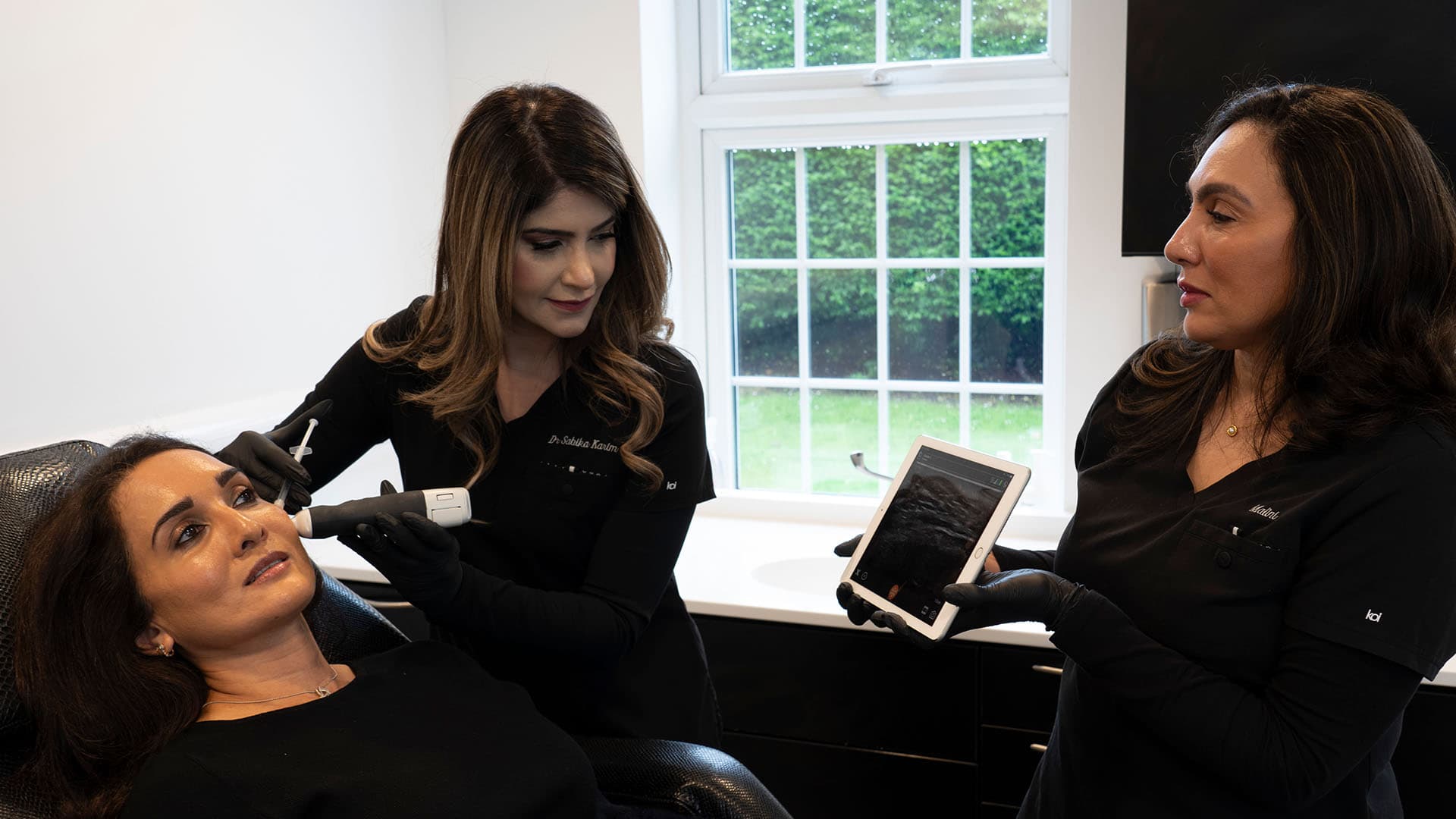
Written by Dr Sabika Karim. 2nd August 2026
The area beneath the eye is one of the most anatomically delicate regions of the face and one of the most commonly treated. A hollow or shadowed under-eye can make a person look persistently tired, older than they feel, or unwell, regardless of how much sleep they have had. Tear trough filler is a non-surgical option that can address this, but it is also a treatment that requires careful patient selection and precise technique.
This article explains the anatomy of the tear trough, what causes the changes you are seeing, and what you can realistically expect from treatment.
The tear trough is the groove that runs from the inner corner of the eye downward and slightly outward along the junction between the lower eyelid and the cheek. In youth, this transition is smooth and the skin below the eye is supported by a small pad of fat that sits flush with the cheek. With age, that fat pad descends or deflates, the overlying skin thins, and the groove becomes more visible as a shadow or hollow.
The dark appearance under the eyes that many patients want to address is usually a combination of several things: the shadow cast by the hollow itself, increased visibility of the underlying muscle through thinning skin, and in some cases genuine pigmentation. Filler is most effective for the structural component, where hollowing and the resulting shadow are the primary issue.
Volume loss beneath the eye is a natural consequence of ageing. Fat that once sat flush with the lower eyelid gradually descends toward the cheek, creating a gap at the tear trough. Bone resorption around the orbital rim reduces the scaffolding that supports the soft tissue above, deepening the hollow further.
Genetics play a significant role. Some patients present with tear trough hollowing in their mid-twenties with no other signs of ageing. In these cases the concern is structural rather than age-related, and filler can produce particularly satisfying results.
Fluid retention and thinning of the skin around the eye also contribute. These factors do not respond to filler in the same way, which is why an accurate assessment before treatment is essential.

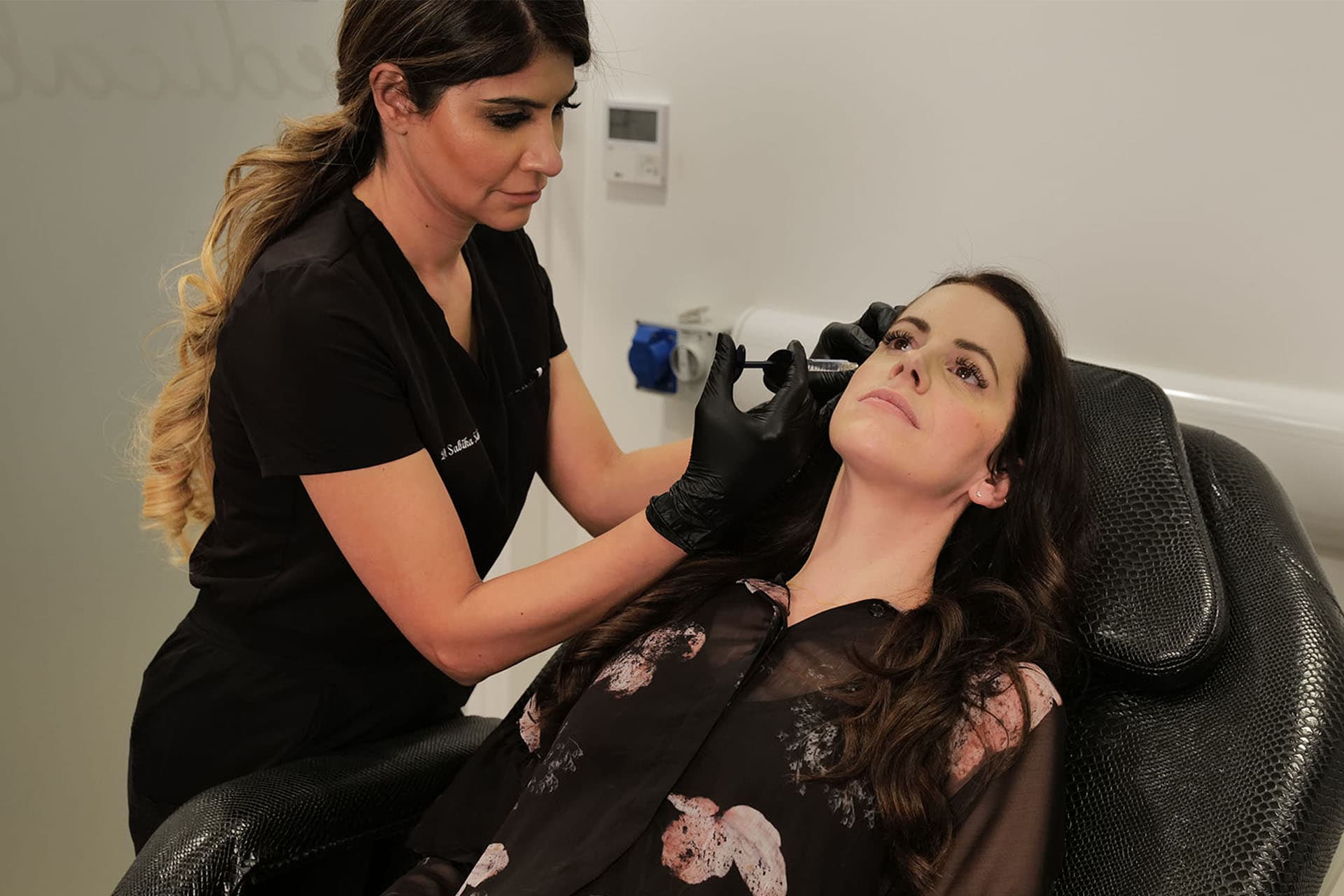
Tear trough filler requires a precise and conservative approach. The under-eye area has a complex vascular anatomy, and the skin in this region is among the thinnest on the face. At Skin Medical, the treatment is performed by clinically trained practitioners who understand the specific considerations of this area.
A very soft, low-viscosity hyaluronic acid filler is used, chosen specifically for the delicate tissue beneath the eye. Placement is typically deep, at or just above the periosteum (the bone surface), to avoid the risk of the Tyndall effect, a bluish discolouration that can occur if filler is placed too superficially in thin skin.
A cannula is often preferred over a needle for this area, as it reduces the risk of bruising and allows the product to be placed more precisely. Most patients require less than 1 ml across both sides.
Some swelling and bruising is common after tear trough filler and can last three to seven days. The under-eye area is particularly prone to fluid accumulation, so swelling may look pronounced initially before settling. Patients should plan for some social downtime in the first few days.
Results become visible as swelling resolves, typically within one to two weeks. When performed well, the improvement is a softening of the shadow and hollow, producing a more rested and refreshed appearance rather than a filled or augmented look. Results last 9 to 18 months depending on the product used and individual metabolism.
A key distinction to understand is the difference between a hollow tear trough and true eye bags. Eye bags are caused by herniation of the orbital fat forward through a weakened septum, creating a convex bulge beneath the eye. Filler does not treat this and, if placed in a patient with prominent eye bags, can worsen the appearance by adding volume to an area that already has excess.
Surgical blepharoplasty removes or repositions the herniated fat and addresses excess skin. For patients with true eye bags, surgery is the appropriate treatment. For patients with a hollow or sunken appearance without significant prolapsed fat, filler is highly effective. Many patients have a combination of both, and a consultation is the only reliable way to assess which is present.
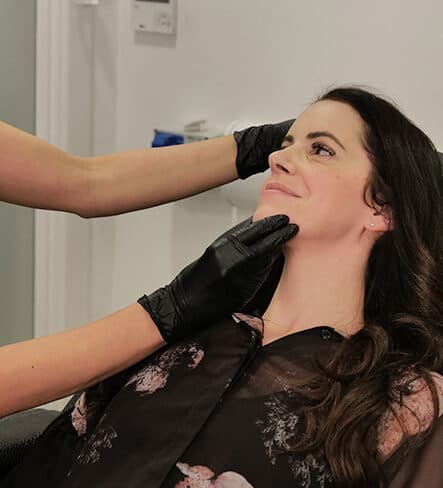
Chin filler is suitable for adults who are unhappy with the projection, shape or symmetry of their chin, but who prefer a non-surgical approach or who are not yet at the point of considering a surgical implant.
It is not a permanent solution. The body gradually breaks down hyaluronic acid, and results typically last 12 to 18 months depending on the product used and how quickly an individual metabolises it. For patients who want a permanent result, surgical augmentation may be a more appropriate long-term option. This is a conversation worth having openly during the consultation so you can make an informed decision.
It is also worth noting that chin filler is best placed by a highly trained practitioner who understands the anatomy of the area. There are important vascular structures in the chin and surrounding regions, and improper placement carries real risks. At Skin Medical, our clinically trained practitioners deliver all injectable treatments with a thorough understanding of facial anatomy.
If you are concerned about hollowing, dark circles or a tired appearance beneath the eyes, a consultation at Skin Medical will establish whether tear trough filler is suitable for you, or whether an alternative approach would be more effective.

Tear trough filler is an injectable hyaluronic acid treatment placed beneath the eye to address hollowing and the shadow it creates. It is used to reduce the appearance of dark circles and a tired look caused by volume loss at the tear trough.
Results typically last between 9 and 18 months, depending on the product used and how quickly your body metabolises hyaluronic acid. The area is metabolically active, so longevity can vary between patients.
Topical anaesthetic is applied beforehand and the procedure is generally well tolerated. Some patients feel mild pressure during injection. Discomfort after treatment is usually minimal, though swelling and bruising are common.
Swelling and bruising typically last three to seven days. Some patients experience more pronounced initial swelling that resolves within two weeks. Most patients feel comfortable returning to work within a few days.
Filler is most effective for dark circles caused by hollowing and the shadow it creates. It does not treat pigmentation-based dark circles. A consultation will identify which type you have and whether filler is likely to help.
Tear trough filler addresses hollowness and volume loss beneath the eye. Eye bag surgery (blepharoplasty) treats herniated orbital fat that creates a convex bulge. These are different concerns and require different treatments. Filler is not appropriate for true eye bags.
Risks include bruising, swelling, the Tyndall effect (a bluish discolouration from superficial placement), asymmetry and, rarely, vascular complications. These risks are significantly reduced by choosing a clinically trained practitioner with experience in this specific area. Hyaluronic acid filler can be dissolved with hyaluronidase if required.
Yes. Some patients develop tear trough hollowing in their twenties due to genetics rather than ageing. In these cases filler can produce particularly effective results, as the surrounding skin quality is typically good.
A clinical assessment is the only reliable way to determine whether your concern is caused by hollowing, fat prolapse, pigmentation or a combination. Book a consultation at Skin Medical for a thorough evaluation before any treatment is recommended.
Most patients require less than 1 ml across both sides. The under-eye area responds to small volumes, and overfilling is one of the most common causes of a poor outcome. A conservative approach with the option to add more at review is always preferred.